Pages

Subscribe:

Ads 468x60px

Showing posts with label ahead. Show all posts

Sunday, July 29, 2012

Gold breakout in question ahead of the FOMC, NFP

Gold_Break-Out_in_Question_Ahead_of_FOMC_NFPs_body_Picture_5.png, Gold Break-Out in Question Ahead of FOMC, NFPs


fundamental Outlook for gold: neutral
Gold is this week with the precious support 2.23% end of trading on Friday significantly stronger at the close of trading. Gold has continued to risk a substantial three-day rally violation of important trend line resistance from 6 June before you fresh monthly record $1630 to follow. Although the advance exposes now key targets over the $1670, we remain next week with a flurry of interest rate decisions and the U.S. non-farm payroll pay barrel risk carefully before the big event. The FOMC interest rate decision and key are the employment data centre for gold traders next week investors weigh prospects for future monetary policy. Although it has proposed, the Fed can look, to a further bout of quantitative easing next week announce it is our view that the Central Bank is unlikely that such a measure at these levels, non-farm payroll print especially before Friday's to implement. It is important to note, that diminish the idea are measures, as every time here to lax-the fed-such measures, the wider effect there staged less effective. As such is with growth and inflation data more or less in line with consensus estimates, hard to justify further easing in the current environment. It is more likely that we will see, that the Central Bank to soft scale back its Outlook for monetary policy next leader and we should see the Committee for the remainder of the year pat are. Relevant data starts on Tuesday with June expected to further improve on the part of consumers personal income and expenditure metrics and ends on Friday with the eagerly-awaited pay non-agricultural wage. Consensus estimates call for the addition of 100 K jobs for the month of July, up from a previous run of only 80 K with the unemployment rate, which is expected to hold steady at 8.2%. Search the data in dramatically below expectations for gold market as a participant's view should benefit come to diversify from the US dollar.
From a technical perspective, gold, breaking out of near three month-long triangle passed a milestone this week with prices education before closing the week at $1620. The outbreak is a bullish note on the yellow metal as a daily sees RSI to breach the 70-mark for the first time since March with topside intermediate now supports eyes on the June high of $1640 by the resistance on the all time highs made in September (currently around $1673) goes back 200-day moving average at $1656 and trendline. Provisional support is former triangle resistance and now support the $1600-level. This interpretation would be only a break below not valid per low at $1563. This means that we next week with the FOMC interest rate decisions, ECB, BoE, and the NFP are expected to draw prices in the near future risk remain neutral on gold prices before key event. -MB

Sunday, July 8, 2012

$ USD to hold steady of the FOMC minutes ahead JPY BoJ take cues

6 July 2012 15: 40 GMT  USD_To_Hold_Steady_Ahead_Of_FOMC_Minutes_JPY_To_Take_Cues_From_BoJ_body_ScreenShot015.png, USD To Hold Steady Ahead Of FOMC Minutes, JPY To Take Cues From BoJalthough US non-farm payrolls report behind the expectations of the market, the Dow Jones FXCM US dollar index fell (ticker: USDollar) 0.30 percent remains of open and continue next week estimate the greenback should escape in which collects safety speed. However as the index the area bounce price action from the previous month transferred claims the overbought signal relative strength to the 30-minute index can be a short-term pullback during North American trade spark and perhaps we see that the dollar still sideways before the FOMC Protocol on tap for next week track how market participants weigh prospects for monetary policy. Actually speculation for additional financial support again surfaced in the midst of the lengthy recovery in the U.S. labor market, but the uptick in the wage growth can the Fed way of moving quantitative easing as the stickiness raises the threat of inflation underlying price growth stimulate.
USD_To_Hold_Steady_Ahead_Of_FOMC_Minutes_JPY_To_Take_Cues_From_BoJ_body_ScreenShot016.png, USD To Hold Steady Ahead Of FOMC Minutes, JPY To Take Cues From BoJAs the USDOLLAR path from the 10.025 figure progress, it seems as if the greenback as a higher low set, and we come in July the index at 10,300 others run one perhaps, see since the upward trend of next form to. In fact, that for a higher dollar and perhaps see break in the relative strength index strengthens our call to head the FOMC Protocol to wake up a bullish response in the reserve currency should we continue to the Central Bank to talk about speculation for a new round of quantitative easing. At the same time, number of data coming from China next week can more SAP risk mood as we expect to see, the 2Q GDP report show an annualised growth rate of 7.7 percent, and a flight to safety can fuel pump concerns about a 'hard landing', such as the Outlook for global growth deteriorates.

USD_To_Hold_Steady_Ahead_Of_FOMC_Minutes_JPY_To_Take_Cues_From_BoJ_body_ScreenShot017.png, USD To Hold Steady Ahead Of FOMC Minutes, JPY To Take Cues From BoJOnce again, although three of the four components weakened against the greenback, led by a 0.85 percent fall in the Australian dollar, the Japanese Yen brought 0.41 percent. With the Bank of Japan interest rate decision on tap for the next week, we should see that Governor Masaaki Shirakawa continue its fundamental prospects for the region raises a leader to beat sound policy, but the Board may continue to support a wait and-see approach, such as the Central Bank. However, since positive real interest rates in Japan further increase the attractiveness of the yen, should we the BoJ still on its easing cycle start see, and the Central Bank should intervene under increased pressure on the foreign exchange market, continue to dampen the prospects for an export-led recovery as the strength in the local currency.

Tuesday, June 26, 2012

$ USD Bullish Trend Ahead Of EU Summit, Reversal JPY Carving On Tap

26 June 2012 15:55 GMT

USD_Carving_Bullish_Trend_Ahead_Of_EU_Summit_JPY_Reversal_On_Tap_body_ScreenShot114.png, USD Carving Bullish Trend Ahead Of EU Summit, JPY Reversal On Tap
Although the Dow Jones-FXCM U.S. Dollar Index (Ticker: USDollar) is 0.17 percent lower from the open, we’re seeing the index bounce off of former support around 10,134, and the greenback may continue to retrace the decline from earlier this month as it breaks out of the bearish trend. Indeed, an inverse head-and-shoulders appears to be taking shape on the 30-minute chart, but we will need a move above the 10,200 figure for the reversal pattern to pan out. As the EU Summit in Brussels takes center stage, the headlines coming out of the euro-area is likely to drive market volatility over the remainder of the week, but the meeting may do little to restore investor confidence as the group struggles to meet on common ground.
USD_Carving_Bullish_Trend_Ahead_Of_EU_Summit_JPY_Reversal_On_Tap_body_ScreenShot115.png, USD Carving Bullish Trend Ahead Of EU Summit, JPY Reversal On TapAlthough the EU is making a greater push for fiscal integration, German policy makers continued to strike down the idea of sharing all liabilities across the region, and we may see a growing rift within the group as the governments operating the fixed-exchange rate system continue to move in their own interest. As a result, dismal developments coming out of Brussels may spark another flight to safety, and we may see the USDOLLAR make another run at the 10,300 as it carves out a higher low in June. As the relative strength index breaks out of the downward trend carried over from May, we should see the ascending channel from earlier this year continue to take shape, and we may see the greenback mark fresh 2012 highs in the coming days as it benefits from safe-haven flows.
USD_Carving_Bullish_Trend_Ahead_Of_EU_Summit_JPY_Reversal_On_Tap_body_ScreenShot116.png, USD Carving Bullish Trend Ahead Of EU Summit, JPY Reversal On TapThree of the four components rallied against the greenback, led by a 0.25 percent advance in the Japanese Yen, and the low-yielding currency may continue to appreciate against its U.S. counterpart as the government increases its effort to balance its public finances. Indeed, Japanese Prime Minister Yoshihiko Noda is pushing for a sales-tax increase for the first time in 15-years, and the move certainly increases the appeal of the Yen as the debt crisis continues to drag on investor confidence. However, the ongoing strength in the local currency may put increased pressure on the Bank of Japan to intervene in the foreign exchange market, and we should see the central bank continue to embark on its easing cycle as policy makers aim to encourage an export-led recovery. As the USDJPY breaks out of the downward trending channel from March, we should see the rebound from 77.65 gather pace, and the pair appears to be carving out a bullish trend amid the series of higher highs paired with higher lows.

€ Euro Eyes 2012 Lows Ahead Of EU Summit, Sterling Weighed By BoE

26 June 2012 13:30 GMT  Talking Points
Euro: EU Makes Greater Push For Fiscal Integration Ahead Of Summit British Pound: BoE Governor King Looks At More QE On Euro-Area Risk U.S. Dollar: Richmond Fed Manufacturing, Consumer Confidence Disappoints Euro: EU Makes Greater Push For Fiscal Integration Ahead Of Summit
The Euro slipped to a low of 1.2454 even as European Commission President Jose Manuel Barroso, European Council President Herman Van Rompuy, European Central Bank President Mario Draghi and Euro Group President Jean-Claude Juncker laid out a tentative framework to foster a tighter-knit fiscal and banking union, and the single currency may face additional headwinds over the next 24-hours of trading should the summit in Brussels disappoint. Indeed, the EU may struggle to meet on common ground as the governments operating under the fixed-exchange rate system continue to act in their own interest, and heightening finance costs across the periphery countries may continue to drag on investor confidence as the group maintains a reactionary approach in addressing the debt crisis.
As we don’t expect to see much coming out of the meeting, we will maintain our bearish outlook for the EURUSD, and the pair may continue to give back the rebound from 1.2287 as the fundamental outlook for the region turns increasingly bleak. According to Credit Suisse overnight index swaps, market participants are now pricing a 44% chance for a 25bp rate cut at the July 5th meeting, but the European Central Bank may have little choice but to implement a range of tools to shore up the ailing economy as the region continues to face a risk for a prolonged recession. In turn, it seems as though the EURUSD has carved out a short-term top in June, and we anticipate to see fresh yearly lows in the exchange rate as the downward trend carried over from 2011 continues to take shape.
British Pound: BoE Governor King Looks At More QE On Euro-Area Risk
The British Pound pared the overnight advance to 1.5650 as Bank of England Governor Mervyn King continue to talk up speculation for more monetary easing, and currency traders may become increasingly bearish against the GBPUSD as the Monetary Policy Committee shows a greater willingness to expand the asset purchase program beyond the GBP 325B target. As uncertainties surrounding the euro-area dampen the outlook for the U.K., Governor King may sound increasingly dovish throughout the second-half of the year, and the GBPUSD may give back the rebound from 1.5268 as it appears to be carving out a short-term top ahead of July. In turn, we may see the pound-dollar fall back towards the 50.0% Fibonacci retracement from the 2009 low to high around 1.5270, but the pair may track sideways in the month ahead should the majority of the MPC stick to its current policy.
U.S. Dollar: Richmond Fed Manufacturing, Consumer Confidence Disappoints
The greenback is regaining its footing going into the North American trade, with the Dow Jones-FXCM U.S. Dollar Index (Ticker: USDOLLAR) bouncing back from a low of 10,132, and the reserve currency may track higher over the next 24-hours of trading as the flight to safety picks up. However, the slowdown in manufacturing paired with the drop in household sentiment appears to be dampening the appeal of the greenback as the Federal Reserve keeps the door open to expand policy further, but we should see the central bank refrain from conducting another round of quantitative easing as the recovery gradually gathers pace. In turn, we remain bullish against the USD, and headlines coming out of Europe may continue to prop up the reserve currency as risk-trends continue to dictate price action across the FX market.

Wednesday, June 20, 2012

Currencies Likely to Consolidate Ahead of Key Fed Event Risk

G20 fails to produce anything meaningful, but somewhat upbeat IMF raises fund contributions; US does not participate All eyes on today’s major event risk in the form of the Fed rate decision Markets remain very well supported and although the G20 failed to produce anything meaningful, this was not a surprise and it may have been enough that the Group maintained a strong commitment to support the global economy through government proponomics. Interestingly, the IMF’s fund contributions were raised to $465B versus 430B previous, but none of the contributions came from the US. While we wouldn’t read too much into this, perhaps the real US contribution will come later today by way of additional action from the Fed. Markets are now looking for the Fed to extend Operation Twist or even potentially offer additional quantitative easing. Any of these moves should be taken as net risk positive and could open the door for additional strength in risk correlated assets. Should the Fed however maintain current policy, there would be risk for a major reversal and risk liquidation.
ECONOMIC CALENDAR

Currencies_Likely_to_Consolidate_Ahead_of_Key_Fed_Event_Risk_______body_Picture_5.png, Currencies Likely to Consolidate Ahead of Key Fed Event Risk TECHNICAL OUTLOOK

Currencies_Likely_to_Consolidate_Ahead_of_Key_Fed_Event_Risk_______body_eur.png, Currencies Likely to Consolidate Ahead of Key Fed Event Risk EUR/USD: While our overall outlook remains grossly bearish, from here we still see room for short-term upside before a fresh lower top is sought out. Look for the latest positive weekly close to open the door for acceleration into the 1.2800-1.3000 area, where fresh offers are likely to re-emerge. Setbacks should be well supported ahead of 1.2400.
Currencies_Likely_to_Consolidate_Ahead_of_Key_Fed_Event_Risk_______body_usd.png, Currencies Likely to Consolidate Ahead of Key Fed Event Risk USD/JPY:The latest setbacks have been rather intense, with the market collapsing through the 200-Day SMA before finally finding support by 77.65. We have since seen attempts at recovery and we contend that the market should continue to break higher, with sights ultimately set on a retest and break of the 2012 highs by 84.20 further up. However, at this point, we will need to see a break and close back above 80.00 to officially alleviate downside pressures and reaffirm bullish outlook.
Currencies_Likely_to_Consolidate_Ahead_of_Key_Fed_Event_Risk_______body_gbp.png, Currencies Likely to Consolidate Ahead of Key Fed Event Risk GBP/USD: Daily studies are now correcting from oversold and from here risks seem tilted to the upside to allow for a necessary short-term corrective bounce after setbacks stalled just shy of the 2012 lows from January. Look for additional upside towards the 1.5800-1.6000 from where a more meaningful lower top is sought out ahead of bearish resumption.

Currencies_Likely_to_Consolidate_Ahead_of_Key_Fed_Event_Risk_______body_usd_1.png, Currencies Likely to Consolidate Ahead of Key Fed Event Risk USD/CHF: While we retain a broader bullish outlook for this pair, with the market seen establishing back above parity over the coming weeks, shorter-term risks are for more of a corrective pullback to allow for the market to establish a fresh higher low. As such, we see risks for weakness over the coming sessions towards the 0.9200-0.9300 area before the market looks to reassert its bullish momentum and broader uptrend.

Tuesday, June 19, 2012

TradeTheNews.com USA market update: QE addicts send shares higher ahead of FOMC patch


The U.S. Market Update: QE addicts send shares higher rate before FOMC

By sending more dependent correction EQ before FOMC
Dow Jones S & P 500, NASDAQ 109 31 9.3

Economic data ******
- (USA) of the FCT / GS weekly sales of chain stores w / e 16th June: 0.0% w / w, 3.6% y / y
- (PL) Poland May Jobs M / M: 0.0% v 0.0% e, A / C: 0.3% and 0.3% v
- (PL) Poland Wages May means of M / M: -2.7% -2.5% ev A / C: 3.8% 4.0% ve
- (United States) May Starts: v 722Ke 708k, Building Permits: 780K 730K V
- (CA) Canada in April large M / M: 1.5% 0.2% ve
- (IS) Israel in May, the first "S" indicator M / M: 0.2% v 0.2% prior
- (USA) Redbook retail w / e 16th June: 2.5% y / y in May BAT: 0.5%
- (EU) foreign exchange reserves of the ECB this week before 226.9B 225.0B v
- (U.S.) jobs in April shocks: M v 3.685Me
- (EU) EFSF sold 1.466B vs. calculations 1.5b indicates 0.1421% 6 months 0.2033% average annual return before v; offers start to finish: 2.1xv 2.5 times before
- (EU) ECB drains 210.5B 210.5B vs. white deposit

The European and American markets are strong gains this morning, as traders expect the FOMC decision tomorrow and the convenience of the probable formation of a government in Greece. New Democratic Party of Greece seems to have a coalition government brought together with another party PASOK and the Left, as with PM Samaras. Overall, the analysts expect the Fed to some form of quantitative easing (QE3) to implement in the session, either by expanding its balance sheet and / or extension of its operating budget. In Europe, opened in the German ZEW survey, the lowest door to rate cuts by the ECB and the softer UK CPI data increases the chances of a rate cut by the Bank of England and QE. In addition to these positive catalysts, housing and construction starts report could help was very good. Residential construction has fallen slightly from tip of 3-1/2 years in April, while approvals have risen sharply, reflecting a nascent recovery in residential construction in progress.

- FedEx, more or less the profit and revenue expectations in its Q4 report, however, expectations for Q1 FY13 and were decidedly disappointing. In addition, the company's operating margin suffered a very strong y / y comp, after several quarters of comp easy comparison. U.S. and international packages daily volume fell last year. Management increased its cost reduction plans. In the press conference said the leader of the European company is very well despite the crisis. FDX is 3%, after losing about 2% in premarket trading.

- Oracle announced its results for the fourth quarter, 3 days earlier than planned after the revelation yesterday's stronger-than-expected quarterly results. The early release came after the news of the imminent departure raises the senior sales concern that the company was stagnating. Note that the firm Q1 earnings guidance was a little soft, while no recovery of the recipe for company material in the first quarter. ORCL part is 3%.

- Walgreen shares are 6% after the company acquired a 45% stake in Alliance Boots, based in Switzerland in a $ 6.7 billion in cash and stock. The purchase represents the first foray of international society, and Walgreen have the opportunity to the rest of Alliance Boots to buy in three years. The company said its Q3 profit first news of the offer, including a 6.6% decline in sales thanks to a terrific compositions by March / April sales development. The company increased its dividend by 22%.

- Discover are financial products and Q2 revenues above expectations, but the benefits of Ay / y basis has been reduced. The results included an ominous sign: see increased its reserves for credit losses by a significant amount. Sales of both cards and transaction volumes have been by healthy margins. DFS shares are 1% in the markets.

- Shares of Microsoft rose by almost 4% this morning after the company tender opening tablet computer. The reactions to the Microsoft Surface device were different: Analysts agree that the specifications of the device are impressive, but few expect the tablet to much dent in the huge advantages of making iPad. In addition, the unit's success could relate to individual users and companies to embrace Windows 8 and radical rethinking of the Windows interface.

Looking ahead ******
- (FI) Finland Parliament votes on the European Stability Mechanism (ESM)
- (U.S.) Diamond convinced JP Morgan
- (MX) G-20 Leaders' Summit in Los Cabos, Mexico
- 11.30 (U.S.) Treasury to sell $ 30 billion in Letters of 4 weeks
- 16.30 (U.S.) API weekly crude inventories
- 17:00 (CO) in Colombia in April trade balance: It is not $ 10, before the basis, imports cif F: No's. V $ 4900000000 before
- 18.50 clock (JP) Balance of trade in goods from Japan in May:-v-522.0B prior 544.4Be WO-v-347.7Be 480.2Be
- 18.50 clock (JP) BoJ minutes

Thursday, June 14, 2012

::: EURUSD Inches Towards 1.26 Ahead of Critical Weekend

-Americans See Biggest Home Equity Jump in 60 Years - Bloomberg
-BofA Beating JPMorgan as BNP Leads French Lenders Retreat - Bloomberg
-Merkel Talks Tough as Spain Debt Costs Soar - Reuters
-Greece's Rural Voters 'on a Tightrope' - WSJ
-Spanish Crisis Deepens - WSJ
Asian/European Session Summary
Ranges were tight in the overnight with most of the majors (save the New Zealand Dollar, which was too by seemingly hawkish commentary from the Reserve Bank of New Zealand) trading in less than half of a percent range against the US Dollar. The US Dollar's high was set early in the session, considering that the rating agencies Egan-Jones and Moody's Investor Services downgraded Spain near the end of each after the US session close yesterday, putting downside pressure on high beta currencies and risk-correlated assets in early Asia today.
Heading into the European session, with the Australian Dollar and the Euro leading the slide, the US Dollar posted a solid comeback following an exceptionally disappointing Italian bond auction. Italy sold €3 billion in 2015 bonds, with yields soaring to 5.30 percent from 3.91 percent a month ago. €627 million in 2019 bonds, with yields up from 5.21 percent to 6.10 percent; and €873 million in 202 bonds, with yields soaring from 5.33 percent to 6.13 percent. Indeed, these bond yields are approaching unsustainable levels, and this has to be of concern to European policymakers; the market is slowly moving on to Italy (though given recent correlations to sovereign credit default swaps, it appears the EURUSD has been tracking the situation in Greece and Spain more so than the one in Italy over the past week).
And while high beta currencies and risk-correlated assets fell back after the Italian bond auction, it is worth noting that some weak US data spurred more speculation for a third round of quantitative easing ahead of the US cash equity open today. But that wasn't the big news; the commentary from Jens Weidmann, head of the Bundesbank (Germany's central bank) and a voting member on the European Central Bank's Governing Council, is the key commentary on the day.
Taking the wind out of hopes for tax union, the head of the Bundesbank said that such a move would require significant "changes to European Union treaties", and that a fiscal union still wouldn't can't solve the issues of "high unemployment" and "poor competitiveness." Furthermore, in a hint about his stance on an ECB rate cut but looser monetary policy, Mr. Weidmann said that its still "too soon to speculate" about the ECB offering another longer-term refinancing operation (LTRO) and that higher inflation rates in the Euro-zone (which would come after an ECB rate cut, in theory) and that it would diminish the central bank's credibility.
Taking a look at credit, Spanish 10-year notes remain significantly weaker, with the yield rising by 14 7-basis points to 6.835 percent. After the auction, the Italian 10 - year note yield has fallen to 6.118 percent.
5 - Min Chart EURUSD: June 14, 2012

EURUSD_Inches_Towards_1.26_Ahead_of_Critical_Weekend_body_EURUSD.jpg, EURUSD Inches Towards 1.26 Ahead of Critical WeekendCharts Created using Marketscope - Prepared by Christopher Vecchio
The New Zealand Dollar is the top performer (again), with the NZDUSD appreciating by 1.02 percent. The Canadian Dollar is also stronger, up by 0.55 percent against the US Dollar. The Euro has rebounded off of its session lows and has exploded back to the 1.25 exchange rate against the US Dollar, with the EURUSD appreciating by 0.34 percent. The Japanese Yen is also up, with the USDJPY depreciating by 0.25 percent.
24 Hour Price Action

EURUSD_Inches_Towards_1.26_Ahead_of_Critical_Weekend_body_Picture_1.png, EURUSD Inches Towards 1.26 Ahead of Critical WeekendEURUSD_Inches_Towards_1.26_Ahead_of_Critical_Weekend_body_Picture_7.png, EURUSD Inches Towards 1.26 Ahead of Critical WeekendKey Levels: 14: 30 GMT

EURUSD_Inches_Towards_1.26_Ahead_of_Critical_Weekend_body_Picture_5.png, EURUSD Inches Towards 1.26 Ahead of Critical Weekend
Thus far, on Thursday, the Dow Jones FXCM Dollar Index (Ticker: USDOLLAR) is trading lower, at 10150.07 at the time this report was written, after opening at 10182.23. The index has traded mostly lower, with the high at 10188.17 and the low at 10147.81.

Tuesday, June 12, 2012

$ US Dollar Holds Support as S & P 500 Signals Weakness Ahead

12 June 2012 strategist 02: 33 GMT prevail: the US Dollar has deflected another attempt to push the price past key support S & P 500 technical positioning while warns of renewed weakness before.
S & P 500 - set prices in a model of candlestick bearish engulfing under load-enabled-resistance a trend line fall of mid-April, that the subway is coming. Initial support aligns to 1292.90, with a break in the 1265.30 exhibition. Trend line resistance is now at 1328.90, with a jump over this targeting to barriers to the 1357.40 and 1392.10.
US_Dollar_Holds_Support_as_SP_500_Signals_Weakness_Ahead_body_Picture_5.png, US Dollar Holds Support as S&P 500 Signals Weakness AheadDaily chart - created with FXCM Marketscope 2.0
Crude oil - price takes 83.30 14.6% of Fibonacci expansion support, challenge the barrier of 23.6% to 81.07. A break below this limit is 80.00 figure and 38.2% Fib to 77.33. 14.6% Expansion has been redesigned as a short term resistance.
US_Dollar_Holds_Support_as_SP_500_Signals_Weakness_Ahead_body_Picture_6.png, US Dollar Holds Support as S&P 500 Signals Weakness AheadDaily chart - created with FXCM Marketscope 2.0
Gold - price remain wedged between 1599.17 and 1582.10, 50% tracing 38.2% Fibonacci levels, respectively. A break already exposes the 61.8% Fib to 1616.23, a barrier reinforced by a trend line that falls in place since early March. Alternatively, a further down the target 1554.73 support, followed by the region of 50 1522-1532 45.
US_Dollar_Holds_Support_as_SP_500_Signals_Weakness_Ahead_body_Picture_7.png, US Dollar Holds Support as S&P 500 Signals Weakness AheadDaily chart - created with FXCM Marketscope 2.0
Us DOLLAR - price continue to search direction over support in the region of 10134-43. A break below opens the door to a challenge to the expansion of Fibonacci 38.2% to 10066. Short term resistance aligns to 10220, 61.8% Fib with already impaired targeting 76.4 percent to 10316 border.
US_Dollar_Holds_Support_as_SP_500_Signals_Weakness_Ahead_body_Picture_8.png, US Dollar Holds Support as S&P 500 Signals Weakness AheadDaily chart - created with FXCM Marketscope 2.0

Monday, June 4, 2012

(*) EURUSD Higher Ahead at NY Open as Asia and Europe Digest NFPs

04 June 2012 13:39 GMT Fundamental Headlines
- Growth Slowdown Seen for Third Year in U.S. Dodging a Recession – Bloomberg
- S&P 500 Valuation Slips 19% Below ’11 – Bloomberg
- Europe Mulls Major Step toward “Fiscal Union” – Reuters
- Feds Eye MF’s False Promise – WSJ
- Germany Signals Crisis Shift – WSJ
Asian/European Session Summary
The first full week of June brings about new opportunity after a dismal May, in which it is looking increasingly like that the Federal Reserve will be forced to implement another round of stimulus to spur the US economy. Nevertheless, the concerns over the Asian and European growth pictures remain at the forefront of global investors’ minds and the start of the week has been relatively bearish in terms of desire for higher yielding currencies and risk-correlated assets.
Although they’ve since bounced back, the Australian and New Zealand Dollars were leading losses among the majors through early Monday as Asian traders dumped the commodity-linked currencies amid the deteriorating growth picture for the world’s largest economy, the US. The downside pressure in the Asian-Oceanic currencies comes ahead of the Reserve Bank of Australia’s June meeting on Tuesday, in which basis swaps are suggesting another 50-basis point rate cut is coming down the pipe. Given the increasingly negative sentiment surrounding the Australian Dollar, there is capacity for the Aussie to rebound if the RBA only cuts by 25-bps instead.
The Japanese Yen also remains quite stronger, now one of the top performing currencies year-to-date behind the US Dollar and the British Pound. In the first quarter, the Yen depreciated by 10.08 percent against the majors covered by DailyFX (AUD, CAD, CHF, GBP, EUR, NZD, USD); but in the second quarter thus far, the Yen has appreciated by 11.13 percent against the same currencies. Indeed, the flight to safety (in this case, the more liquid currencies like the Japanese Yen and the US Dollar) has hampered efforts by the Bank of Japan and the Japanese Ministry of Finance to stem the Yen’s appreciation. Earlier today, BoJ Governor Masaaki Shirakawa said that the BoJ is monitoring “the recent appreciation of the Yen,” while also noting that “the bank carefully monitors the development of the foreign exchange rate from the viewpoint of how it affects the economy through its impact on business sentiment.” While the continued flight to safety will keep demand for the Yen high, it is likely that the BoJ steps in to halt the Yen’s strength, if only momentarily.
Taking a look at credit, US Treasuries have started to come off a bit, with the 10-year Note yield rising back to 1.514 percent ahead of the cash equity open. In Europe, peripheral yields have improved as well, led by Greece and Italy on the longer-end of the curve and by Italy and Portugal on the shorter-end. The Portuguese 2-year note yield dropped by 17.9-bps to 9.552 percent, while the Italian 2-year note yield fell back to 4.100 percent. Undoubtedly the positive developments have been in part due to the positive results of the European Troika’s fourth quarterly review of Portugal’s economic program.
EURUSD 5-min Chart: June 4, 2012

EURUSD_Higher_Ahead_at_NY_Open_as_Asia_and_Europe_Digest_NFPs_body_x0000_i1028.png, EURUSD Higher Ahead at NY Open as Asia and Europe Digest NFPsCharts Created using Marketscope – Prepared by Christopher Vecchio
The New Zealand Dollar has been the top performer, gaining 0.62 percent against the US Dollar to start the week. The Japanese Yen has been the worst performer, with the USDJPY appreciating by 0.20 percent. The Euro’s rally has really picked up steam around the US cash equity open, and the EURUSD is now up 0.46 percent on the day. Quizzically, the Swiss Franc is the second best performer, up 0.49 percent.
24-Hour Price Action

EURUSD_Higher_Ahead_at_NY_Open_as_Asia_and_Europe_Digest_NFPs_body_Picture_7.png, EURUSD Higher Ahead at NY Open as Asia and Europe Digest NFPsEURUSD_Higher_Ahead_at_NY_Open_as_Asia_and_Europe_Digest_NFPs_body_Picture_1.png, EURUSD Higher Ahead at NY Open as Asia and Europe Digest NFPsKey Levels: 12:45 GMT

EURUSD_Higher_Ahead_at_NY_Open_as_Asia_and_Europe_Digest_NFPs_body_Picture_4.png, EURUSD Higher Ahead at NY Open as Asia and Europe Digest NFPs
Thus far, on Monday, the Dow Jones FXCM Dollar Index (Ticker: USDOLLAR) is trading lower, at 10211.64 at the time this report was written, after opening at 10257.60. The index has traded mostly lower, with the high at 10271.92 and the low at 10211.64.

Monday, May 28, 2012

-$ USD Eyes Fresh Highs Ahead Of Correction, JPY Preserves Bullish Trend

28 May 2012 15:55 GMT

Index
Last
High
Low
Daily Change (%)
Daily Range (% of ATR)
DJ-FXCM Dollar Index
10180.13
10183.25
10148.44
-0.33
70.80%

USD_Eyes_Fresh_Highs_Ahead_Of_Correction_JPY_Preserves_Bullish_Trend_body_ScreenShot051.png, USD Eyes Fresh Highs Ahead Of Correction, JPY Preserves Bullish Trend
The Dow Jones-FXCM U.S. Dollar Index (Ticker: USDollar) is 0.33 percent lower from the open after moving 71 percent of its average true range, but we may see the dollar carve out a fresh high going into June as the upward trending channel from earlier this month continues to take shape. Indeed, the topside break in the 30-minute relative strength index dampens the likelihood of seeing a short-term correction in the index, and the bullish sentiment underlining the reserve currency may gather pace as it continues to benefit from safe-haven flows. However, we may see the greenback consolidate over the coming days as market participants look forward to the U.S. Non-Farm Payrolls report due out on Friday, and the report may ultimately trigger a short-term correction in the greenback should it foster speculation for additional monetary support.
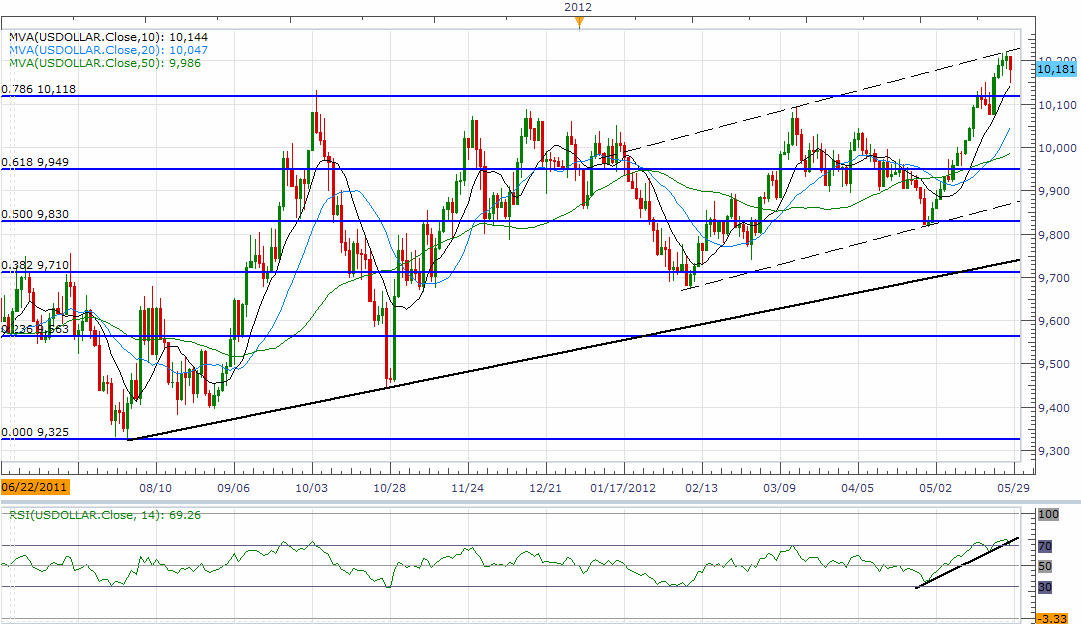
USD_Eyes_Fresh_Highs_Ahead_Of_Correction_JPY_Preserves_Bullish_Trend_body_ScreenShot052.png, USD Eyes Fresh Highs Ahead Of Correction, JPY Preserves Bullish TrendAs the USDOLLAR comes off of the upper bounds of the ascending range, the daily chart continues to foreshadow a short-term correction, and we will keep a close eye on the relative strength index as it fails to maintain the upward trend from the beginning of the month. As the oscillator comes back from overbought territory, a move below 70 could pave the way a larger move to the downside, but we will look for a higher low in the index as it maintains the upward trending channel from earlier this year. In turn, we may see the dollar revert back to the 61.8 percent Fibonacci retracement around 9,949, but it’s imperative that the greenback holds above the 9,900 figure to maintain a bullish outlook for the USD. In turn, we will be looking to buy dips as we head into June, and the upward trend in the reserve currency may continue to gather pace in the second-half of the year as the Federal Reserve moves away from its easing cycle.
USD_Eyes_Fresh_Highs_Ahead_Of_Correction_JPY_Preserves_Bullish_Trend_body_ScreenShot053.png, USD Eyes Fresh Highs Ahead Of Correction, JPY Preserves Bullish Trend The greenback weakened across the board on Monday, led by a 0.85 percent advance in the Australian dollar, while the Japanese Yen climbed 0.29 as the Bank of Japan talked down speculation for additional asset purchases. Indeed, the policy meeting minutes reiterated that the BoJ is not monetize government debt as market participants look for more easing, and it seems as though the central bank will carry its current policy into the second-half of the year even as Governor Masaaki Shirakawa pledges to pursue ‘powerful’ monetary easing. As the USDJPY threatens the downward trend carried over from March, we are looking for a close above the 20-Day SMA (79.75) to see a meaningful rebound in the exchange rate, and we will be closely watching the 79.00 figure as it appears to be holding up as support.

Saturday, May 26, 2012

$- Dollar Notches a Four Day Rally, Looking Ahead to Risk and NFPs

Dollar Notches a Four Day Rally, Looking Ahead to Risk and NFPs Euro May Need a Crisis Upgrade to Push Beyond its 22-Month Lows Against USD British Pound Pulled between Euro-Area Trouble and Tumbling Rates Swiss Franc Faces Euro, SNB and GDP Pressures Next Week Canadian Dollar: GDP May Resync Currency to Rate Outlook Australian and New Zealand Dollars May Find a Yield Extreme if Not Risk Extreme Gold Closes the Week Near the Center of Its Range Despite Dollar Progress Dollar Notches a Four Day Rally, Looking Ahead to Risk and NFPs
Though we couldn’t give the dollar top marks in its performance against all its counterparts to end this past week, the safe haven currency carried enough strength to outperform its fundamental obligations. While US equity benchmarks and high-yield carry pairs like AUDUSD showed more congestion than anti-risk trend, the Dow Jones FXCM Dollar Index drove higher for a fourth consecutive day through Friday’s close. And, despite lackluster momentum, the fresh 17-month high offers a sense of the underlying trend. That said, all trends come to points of respite and eventually reversal. A precursor to a technical reversal is consolidation, and the lead up to a fundamental tide shift for the greenback is lax correlations and diminished craving for liquidity-at-any-cost. A decision on whether the dollar continues or retraces will likely be made this week.
As we have repeated frequently this past week, the greenback’s performance depends on the direction and intensity of risk trends. Under normal circumstances, the balance between risk (volatility or the threat of losses) versus reward (yield, yield expectations, growth, etc) will determine a currency’s standing. For the dollar, however, a vow by the Fed to keep rates exceptionally low for an extended period (though that policy stance generally suits a low rate environment across the globe) isolates the unit’s safe haven / reserve status. The combination of fading rate forecasts for the highest yielding currencies, an intensified Euro Zone financial crisis (with potential for global spread) and the capitulation of ‘stimulus protected’ US equity markets has been an overwhelming hit to sentiment and thereby boost to the dollar. This is not a trend that will likely change again easily. On the other hand, it will be prone to congestion as investors reassess. What we need for drive is catalysts.
Using the docket alone, it is difficult to point out obvious sparks to tip the risk / reward balance. What could work against the dollar (as it curbs volatility) though are the holiday on Monday and NFPs on Friday. A lack of participation generally curbs the froth of fear and greed while the wait-and-see in the lead up to a week-end event could sideline participants. If we want to find catalysts that can overcome this curb on volatility, we need to look once again to those concerns which tap into deeper emotions – like the fear of Europe’s crisis infecting the globe.
Euro May Need a Crisis Upgrade to Push Beyond its 22-Month Lows Against USD
Europe’s headlines of an uncertain Greek election, Portugal and Ireland’s potential inability to return to the debt markets next year, and rising bond yields are growing stale. We have seen these warnings before, and the market is efficient enough to price them in (if warranted). Recently, more attention has been paid to the more distant concerns because immediate losses are starting to rack up and the countdown for serious crises has been reduced from months to weeks (and even days). That said, officials have once again bought themselves a period of time, taking the pressure off immediate euro deleveraging. More and more, we need a catalyst to further the uncertainty. The ECB’s report of bond purchases should be interested given Spain’s requests. Generally, Spain will represent the greatest unknown and unadjusted risk.
British Pound Pulled between Euro-Area Trouble and Tumbling Rates
The sterling is a fundamentally confused currency. On the one hand, it stands to play the role of safe haven to Euro-area capital outflows that want to stay within geographic proximity to home and avoid the manipulation game the Swiss are playing. On the other, the UK would be the first domino to fall should the Euro Zone crisis spread beyond its own boarder – thereby making the pound distinctly risky. That said, a rebound for the euro, could be a rebound for the pound. Then there is the ‘return’ aspect. Though BoE Member Posen didn’t return to the dovish camp last meeting, the market sees the risk of easing and as 10-year Gilt yields plunge record lows (with more fervor than just safe haven flow).
Swiss Franc Faces Euro, SNB and GDP Pressures Next Week
The EURCHF volatility of this past week was exciting – it’s hard not be excited when a pair that has averaged a daily range of 5-8 pips shows a meaningful swing. However, should we expect a more active market just because of this one instance? No doubt, the jump last week signals to the market that a shift in speculative interests can move this market, and it could also be a temperature gauge for the SNB. In the upcoming week we need to watch the severity of anti-euro flows, SNB commentary and even the 1Q GDP reading that is on the docket.
Canadian Dollar: GDP May Resync Currency to Rate Outlook
From a purely fundamental perspective, the Canadian dollar is perhaps one of the best standing majors. For a quick tally, it enjoys proxy safe haven status due to the US connection, the United States is a permanent buyer of Canadian goods, resource investment is strong, financial cracks are minimal and the BoC is the only policy authority amongst the majors that is still seen entertaining a rate hike in the coming year. Despite all of this, though, the loonie has struggled (against most counterparts). Perhaps the 1Q GDP reading can rebalance the view.
Australian and New Zealand Dollars May Find a Yield Extreme if Not Risk Extreme
Picking the tops and bottoms in sentiment trends is perhaps the most unsuccessful effort that can be made by a fundamental trader. Yet, risk appetite defines carry interest and thereby directs the high yield Australian and New Zealand dollars. If the prevailing risk aversion trend revives itself next week, both currencies will extend their already hearty selloffs. Yet, we find ourselves in a frustrating transition period. That said, congestion itself could leverage a reversal where balanced sentiment cannot provide. Both the RBA and RBNZ rate expectations has dropped sharply over recent months. If expectations of risk level off, the outlook for cuts could as well. That would be a boon for these currencies.
Gold Closes the Week Near the Center of Its Range Despite Dollar Progress
We have seen congestion from the S&P 500 and AUDUSD over the past week, but gold threw the brakes on its tumble well before most other risk sensitive assets. Why is that: because gold is not a high-yield or exceptionally risk asset that needs to be unwound as appetite for return trades off for uncertainty. Both gold and its primary pricing instrument (the dollar) are safe havens. The metal is an inflation and currency-hedge. The greenback is outmatched in liquidity. To take out 1525, fear needs to escalate to new heights.
For Real Time Forex News, visit: http://www.dailyfx.com/real_time_news/
**For a full list of upcoming event risk and past releases, go to www.dailyfx.com/calendar
ECONOMIC DATA
Next 24 Hours
GBP Hometrack Housing Survey (MoM)
GBP Hometrack Housing Survey (YoY)
JPY Corporate Service Price (YoY)
RBA’s Stevens Speaks on Australian Economy
ECB’s Knot Speaks on Financial Stability
ECB Announces Bond Purchases (SMP)
SUPPORT AND RESISTANCE LEVELS
To see updated SUPPORT AND RESISTANCE LEVELS for the Majors, visit Technical Analysis Portal
To see updated PIVOT POINT LEVELS for the Majors and Crosses, visit our Pivot Point Table
CLASSIC SUPPORT AND RESISTANCE –EMERGING MARKETS 18:00 GMTSCANDIES CURRENCIES 18:00 GMT
INTRA-DAY PROBABILITY BANDS 18:00 GMT

Friday, May 18, 2012

Euro Tests For Support Ahead Of G8 Summit, Sterling To Lag Behind

AppId is over the quota
Talking Points

Euro: Remains Oversold, Germany Vows Additional Assistance For Greece British Pound: Rebounds Ahead Of Key Event Risks, BoE Posen Mulls More QE U.S. Dollar: Index Falls Back From Fresh 2012 High Ahead Of G8 Summit Euro: Remains Oversold, Germany Vows Additional Assistance For Greece

The Euro bounced back from a fresh monthly low of 1.2641 as a spokesperson for the EU denied rumors that the group is working on a contingency plan for a Greek exit, while German Chancellor Angela Merkel showed an increased willingness to further assist Greece as the sovereign debt crisis continues to dampen the outlook for the region. At the same time, German Finance Minister Wolfgang Schaeuble encourage the EU to ‘form a common position as quickly as possible’ as the group heads into G8 meeting, but warned that debt crisis may continue to weigh on the financial market for another two-years as European policy makers struggle to restore investor confidence.

As the EU maintains a reactionary approach in addressing the risk for contagion, the European Central Bank is certainly coming under increased pressure to shore up the ailing economy, and there’s speculation that the Governing Council will take additional steps at the next meeting on June 6 as the fundamental outlook for the region turns increasingly bleak. According to Credit Suisse overnight index swaps, investors are currently pricing an 11% chance for a 25bp rate, but the ECB may show an increased willingness to target the benchmark interest rate as the non-standard measures have a limited impact in addressing the risks surrounding the region. As the EURUSD continues to trade above the 23.6% Fibonacci retracement around 1.2640-50, it seems as though the pair is carving out a short-term base, and we will be keeping a close eye on the relative strength index as it continues to sit in oversold territory. Should the oscillator cross back above 30 next week, we will be watching former support around the 1.3000 figure for new resistance, and we will be looking for opportunities to sell the single currency as we expect to see fresh 2012 lows in the exchange rate.

British Pound: Rebounds Ahead Of Key Event Risks,BoE Posen Mulls More QE

The British Pound regained its footing during the overnight trade, with the GBPUSD snapping back from a fresh monthly low of 1.5731, but the economic developments on tap for the following week may drag on the sterling as the Bank of England turns increasingly dovish. Indeed, we’re expecting to see the headline reading for inflation expand at the slowest pace since September 2010, while the BoE Minutes may reinforce expectations for more quantitative easing as the central bank sees a renewed risk of undershooting the 2% target for price growth. Indeed, Monetary Policy Committee member Adam Posen argued that he may have been overly optimistic on the economy after scaling back his vote to expand the asset purchase program by another GBP 25B, and curbed his outlook for core of inflation despite the stickiness in price growth. Even though we’re seeing the RSI hold above oversold territory, we may see the recent weakness in the GBPUSD gather pace next week as market participants increase bets for additional monetary support, and we may see the pair come up against the 1.5600 figure as it continues to search for support.

U.S. Dollar: Index Falls Back From Fresh 2012 High Ahead Of G8 Summit

The greenback is struggling to hold its ground on Friday, with the Dow Jones-FXCM U.S. Dollar Index (Ticker: USDOLLAR) falling back from a fresh yearly high of 10,153, and the reserve currency may consolidate throughout the North American trade amid the rebound in risk-taking behavior. As the G8 Summit comes into focus, the group may try to talk up market sentiment, but we don’t expect to see any major developments over the weekend as European policy makers continue to look at the ECB for relief. Nevertheless, as the economic docket for the following week is expected to instill an improved outlook for the U.S., a slew of positive developments should continue to dampen speculation for additional monetary support, and we may see the greenback track higher in the week ahead as the Fed moves away from its easing cycle.

--- Written by David Song, Currency Analyst

To contact David, e-mail dsong@dailyfx.com. Follow me on Twitter at @DavidJSong

To be added to David's e-mail distribution list, send an e-mail with subject line "Distribution List" to dsong@dailyfx.com.

Will the EUR/USD Resume the Downward Trend From 2011? Join us in the Forum

Related Articles: Weekly Currency Trading Forecast

FX Upcoming

Nationwide Department Store Sales (YoY) (APR)

Tokyo Department Store Sales (YoY) (APR)

German Producer Prices (MoM) (APR)

Slowest pace of growth since June 2010.

German Producer Prices (YoY) (APR)

Italian Industrial Orders s.a. (MoM) (MAR)

Rises for the first time since December.

Italian Industrial Orders n.s.a. (YoY) (MAR)

Italian Industrial Sales s.a. (MoM) (MAR)

Fails to grow for the second time in 2012.

Italian Industrial Sales n.s.a. (YoY) (MAR)

Consumer Price Index (MoM) (APR)

Headline and core inflation rises for the first time since February, raising the scope for a BoC rate hike.

Consumer Price Index (YoY) (APR)

Bank Canada CPI Core (MoM) (APR)

Bank Canada CPI Core (YoY) (APR)


View the original article here

Monday, May 14, 2012

$ Dollar Aims Higher on Greece Jitters, Eurogroup Meeting on Tap Ahead

Talking Points
US Dollar Aims Higher as S&P 500 Stock Index Futures Point to Risk Aversion Greek Government Impasse Overshadows China’s Weekend Interest Rate Cut Eurozone Finance Ministers’ Meeting, Italian and Spanish Debt Sales Key Ahead The US Dollar pushed higher to start the trading week as stocks fell in overnight trade, driving demand for the go-to haven currency. The MSCI Asia Pacific regional benchmark equity index fell 0.6 percent as Greek lawmakers failed to come up with an agreement on a ruling coalition at meeting over the weekend. Traders are concerned that a lingering impasse will push Athens to fall short of its obligations under the terms of the EU/IMF bailout, paving the way for Greece’s ejection from the Eurozone and possibly even the overall EU.
This would be an unprecedented development with effectively unpredictable practical implications for financial markets, fueling a broadly defensive tone and overshadowing risk-supportive news of a Chinese rate cut. Beijing announced over the weekend that reserve requirement ratios (RRRs) will be cut 50bps to 20 percent effective May 18. The move could have been expected to boost risk appetite and drive stocks-linked currencies higher on hopes of better-supported growth in the world’s second-largest economy were it not for Greek-related headwinds.
Looking ahead, S&P 500stock index futures are pointing sharply lower, hinting risk aversion is likely to continue driving the greenback higher against most of its leading counterparts. The spotlight is on a meeting of Eurozone Finance Ministers in Brussels, with traders on the lookout for any clues about a possible way forward beyond the Greek stalemate. Italy and Spain are also due to issue debt, with markets keeping a close eye on average yield and bid-to-cover readings to gauge the extent to which Athens-born jitters are spilling over elsewhere.
Asia Session: What Happened
Performance Services Index (APR)
Retail Sales Ex Inflation (QoQ) (1Q)
Owner-Occup. Value of Loans (MoM) (MAR)
Euro Session: What to Expect
German Wholesale Price Index (MoM) (APR)
German Wholesale Price Index (YoY) (APR)
France Current Account (€) (MAR)
Producer & Import Prices (MoM) (APR)
Producer & Import Prices (YoY) (APR)
Italian CPI (NIC incl. tobacco) (MoM) (APR F)
Italian CPI (NIC incl. tobacco) (YoY) (APR F)
Italian CPI – EU Harmonized (MoM) (APR F)
Italian CPI – EU Harmonized (YoY) (APR F)
Spain to Sell 364-518 Day Bills
Italian General Government Debt (€) (MAR)
Euro-Zone Industrial Production (YoY) (MAR)
Euro-Zone Industrial Production (MoM) (MAR)
Euro Zone Finance Ministers Meet in Brussels
Critical Levels

Wednesday, May 9, 2012

:Currency Rallies Viewed As Corrective; Fresh US Dollar Upside Ahead

08 May 2012 10: 55 GMT Risk rallies viewed as technical corrections; look to sell Euro consolidating above 1.3000 ahead of next drop Investors digesting implications of latest French and Greek elections Spain back in focus as the country attempts to rescue local bank German industrial production comes in well above consensus Australian government announces return to budget surplus Although we have seen a bit of a bounce in risk correlated assets, we contend that the rally is nothing more than some minor consolidation ahead of the next wave of risk liquidation. The Euro managed to close back above 1.3000 on Monday, but from here, we expect any additional rallies to be very well capped ahead of 1.3200 in favor of an eventual retest of the 2012 lows from January at 1.2620. Market participants are still digesting the weekend election results out of France and Greece, and there is a good deal of concern as to whether the newly elected governments will acceded to the austerity measures imposed to ease the debt crisis. In Greece, the situation is highly uncertain, with the lack of a clear majority potentially creating a situation where austerity measures might be significantly reduced in order to appease the opposition. Elsewhere, Spain is back in the headlines, as the country attempts to rescue its third largest bank.
Relative performance versus the USD Tuesday (as of 10: 45GMT)
JPY - 0.21 %
CHF + 0.17 %
EUR + 0.21 %
GBP + 0.30 %
CAD + 0.43 %
NZD - 0.54 %
AUD - 0.59 %
Moving on, economic data continues to show signs of weakness, and the softer results once again highlight the fragile state of affairs in which the global economy lies. Nevertheless, the Euro did manage to hold above 1.3000 in European trade, aided by some solid auction results and a very impressive German industrial production print. Meanwhile, our Euro / Sterling long position (long @ 0.8050) found some bids on softer overnight RICS house price data, while in Australia, the government announced the country would return to a budget surplus of $A1.5B in 2012/2013. Still, overall, we expect risk correlated currencies and global equities to be very well offered on any rallies in favor of more bearish price action.
ECONOMIC CALENDAR
Currency_Rallies_Viewed_As_Corrective_Fresh_US_Dollar_Upside_Ahead_body_Picture_5.png, Currency Rallies Viewed As Corrective; Fresh US Dollar Upside Ahead
TECHNICAL OUTLOOK
Currency_Rallies_Viewed_As_Corrective_Fresh_US_Dollar_Upside_Ahead_body_eur.png, Currency Rallies Viewed As Corrective; Fresh US Dollar Upside Ahead
EUR/USD: The market has finally cleared some key support by 1.3000 and the break opens the door for deeper setbacks over the coming days towards the 2012 lows from January at 1.2620. However, short-term technical studies will need to unwind from oversold readings before we are to see any extended declines below 1.3000, and we recommend looking to sell into rallies into the 1 3150 - 1 3200 where a fresh lower top is now sought. Ultimately, only back above 1.3300 would delay.
Currency_Rallies_Viewed_As_Corrective_Fresh_US_Dollar_Upside_Ahead_body_usd.png, Currency Rallies Viewed As Corrective; Fresh US Dollar Upside Ahead
USD/JPY: The latest pullback from the 2012, UST highs is viewed as corrective and it looks as though the market could still see a bit more weakness before considering the possibility for the formation of a medium-term higher low. Overall, this is a market that has undergone a major structural shift in recent months and we now see the pair in the early stages of a longer-term up-trend. Ultimately, only a weekly close back under 78.00 would negate.

Currency_Rallies_Viewed_As_Corrective_Fresh_US_Dollar_Upside_Ahead_body_gbp.png, Currency Rallies Viewed As Corrective; Fresh US Dollar Upside Ahead
GBP/USD: Finally starting to see signs of a medium-term top and potential 2012 high after the market has stalled and retreated from the area 1.6300. Key support now comes in by 1.6075 and a break and closed below this level will confirm bearish bias and accelerate declines towards 1.5800 further down. Ultimately, only a break back above 1.6300 would negate and give reason for reconsideration.
Currency_Rallies_Viewed_As_Corrective_Fresh_US_Dollar_Upside_Ahead_body_usd_1.png, Currency Rallies Viewed As Corrective; Fresh US Dollar Upside Ahead
USD/CHF: Our core constructive outlook remains well intact with the latest setbacks very well supported by psychological barriers at 0.9000. It now looks as though the market could be looking to carve a fresh higher low, and we will be looking for additional upside back towards the recent range highs at 0.9335 over the coming sessions. Above 0.9335 should then accelerate gains towards the 2012 highs by 0.9600 further up. Ultimately, only back under 0.9000 delays and gives reason for pause.

Thursday, May 3, 2012

~~~ Commodities Drop on China Growth Fears, ECB and US Data Key Ahead

Crude Oil, Copper Sold on China Growth Fears – ECB and US Data Set Eyed Ahead Gold and Silver Look to Dollar’s Response to Risk Trends, QE3 Bets for Direction Commodity prices are extending Asia-session losses in early European trade, weighed down by a drop in China’s Non-manufacturing PMI index on fears that one the world’s top-two consumers of raw materials is slowing. Looking ahead, all eyes are on the European Central Bank interest rate decision. Traders are looking for guidance on steps policymakers are prepared to take to alleviate what appears to be deepening recession after yesterday’s sharp slump in final PMI readings and another record-high unemployment print.
An outright rate cut seems unlikely this time around with inflation stubbornly high at 2.6 percent. However, if Mario Draghi and company invoke the ECB’s singular mandate of price stability to justify inaction and fail to reassure markets with the prospect of forthcoming easing in the months ahead, worries about Eurozone-bornheadwinds facing global output threaten to weigh on risk appetite. This bodes ill for cycle-sensitive commodities including crude oil and copper, while gold and silver may follow lower as haven-seeking capital flows boost the US Dollar.
Later in the day, the spotlight turns to US Jobless Claims and the ISM Non-manufacturing Composite figures. These are likely to be interpreted in terms of their implications for the likelihood of Fed QE3, which means softer outcomes could counter-intuitively support risk appetite and weigh on the Dollar (both via sentiment trend and dilution fears) to the benefit of precious metals. With that in mind, significant follow-through on this front may be lackingas traders reserve judgment until after Friday’s all-important Nonfarm Payrolls data point crosses the wires. This means any negative carry-over from the ECB’s outing may have scope to hold sway over price action.
WTI Crude Oil (NY Close): $105.22 // -0.94 // -0.89%
Prices put in a Harami candlestick pattern below resistance at a falling trend line set from late February, hinting a pullback may be ahead. Initial support lines up in the 104.90-105.15 area, marked by a horizontal barrier and the 50% Fibonacci retracement level. A break below here exposes rising trend line support at 102.42. Resistance is now at 106.03 and bolstered by the 61.8% Fib at 106.27.

Commodities_Drop_on_China_Growth_Fears_ECB_and_US_Data_Key_Ahead_body_Picture_3.png, Commodities Drop on China Growth Fears, ECB and US Data Key Ahead Daily Chart - Created Using FXCM Marketscope 2.0
Spot Gold (NY Close): $1653.50 // -8.93 // -0.54%
Prices followed a Spinning Top candle below trend line resistance capping gains since late March with a push lower. Sellers face initial support at 1637.95, the 23.6% Fibonacci expansion, with a break lower exposing the 38.2% level at 1611.77. Trend line resistance is now at 1664.48.

Commodities_Drop_on_China_Growth_Fears_ECB_and_US_Data_Key_Ahead_body_Picture_4.png, Commodities Drop on China Growth Fears, ECB and US Data Key Ahead Daily Chart - Created Using FXCM Marketscope 2.0
Spot Silver (NY Close): $30.64 // -0.34 // -1.08%
Prices are recoiling from resistance at 31.36, a former support reinforced by a downward-sloping trend line set from the April 3 high. Sellers face initial barriers at 29.96, the April 25 low, followed by the bottom of a falling channel set from early March now at 29.50. Near-term resistance is at 31.08.

Commodities_Drop_on_China_Growth_Fears_ECB_and_US_Data_Key_Ahead_body_Picture_5.png, Commodities Drop on China Growth Fears, ECB and US Data Key Ahead Daily Chart - Created Using FXCM Marketscope 2.0
COMEX E-Mini Copper (NY Close): $3.788 // -0.056 // -1.46%
Prices turned lower as expected after putting in a Hammer candlestick below support-turned-resistance at a rising trend line set from mid-February. Initial support lines up at 3.713. Trend line resistance is now at 3.855.

Commodities_Drop_on_China_Growth_Fears_ECB_and_US_Data_Key_Ahead_body_Picture_6.png, Commodities Drop on China Growth Fears, ECB and US Data Key Ahead Daily Chart - Created Using FXCM Marketscope 2.0

Friday, April 27, 2012

$ Dollar Gains on Spain Rating Cut, US GDP Report on Tap Ahead

27 April 2012 07:09 GMT  Talking Points Dollar, Yen Gain on Haven Demand as S&P Cuts Spain’s Credit Rating US GDP Report May Force FX Markets to Rethink Likelihood of QE3 Italian Bond Yields on Returning Credit Stress Ahead of Debt Auction The US Dollar (ticker: USDollar) and Japanese Yen outperformed in overnight as Asian stocks declined, boosting demand for the go-to safe haven currencies, after Standard & Poor’s cut Spain’s sovereign credit rating and assigned it a negative outlook, saying a recession will undermine the government’s ability to reduce the budget deficit. Eurozone crisis fears overshadowed would-be downward pressure on the Yen after the Bank of Japan expanded its stimulus efforts by a cumulative ¥10 trillion yen, broadly in line with market expectations.
Futures tracking key European stock indexes and the S&P 500 are sharply lower, hinting the risk-averse is set to carry forward into Wall Street trade. On the data calendar, the focus is first-quarter US Gross Domestic Product figures, where expectations point to a 2.5 percent annualized quarterly increase after a 3 percent rise in the three months through December.
The result is likely to be interpreted in the context of this week’s FOMC policy meeting, with a better-than-expected outcome carrying the possibility of reminding traders that Ben Bernanke’s commentary was hardly as supportive of QE3 as traders’ initial reaction suggested. Alternatively, a disappointing print will further fuel stimulus bets and may renewed downward pressure on the greenback.
Elsewhere, an Italian bond auction will be interesting to watch as Eurozone debt crisis fears heat up anew. Rome is scheduled to sell a tranche of 2016-2022 debt, with investors keeping a close eye on average yield levels to gauge the severity of returning funding stress. The spread between yields on benchmark German 10-year bonds and Italian equivalents rose 14bps ahead of the sale, tapping a three-month high at 410bps.
Asia Session: What Happened
Markit/JMMA Manufacturing PMI (APR)
Overall Household Spending (YoY) (MAR)
National CPI Ex-Fresh Food (YoY) (MAR)
National CPI Ex Food, Energy (YoY) (MAR)
Tokyo CPI Ex-Fresh Food (YoY) (APR)
Tokyo CPI Ex Food, Energy (YoY) (APR)
Industrial Production (MoM) (MAR P)
Industrial Production (YoY) (MAR P)
Industrial Profits YTD (YoY) (MAR)
MNI Business Confidence Survey (APR)
Vehicle Production (YoY) (MAR)
Construction Orders (YoY) (MAR)
Annualized Housing Starts (MAR)
Euro Session: What to Expect
German GfK Consumer Confidence Survey (MAY)
German Import Price Index (MoM) (MAR)
German Import Price Index (YoY) (MAR)
French Producer Prices (MoM) (MAR)
French Producer Prices (YoY) (MAR)
French Consumer Spending (MoM) (MAR)
French Consumer Spending (YoY) (MAR)
KOF Swiss Leading Indicator (APR)
Critical Levels

Thursday, April 19, 2012

Scandis Consolidate Ahead of Next Major Downside Extension

 18 April 2012 05:48 GMT Eur/Sek Setbacks have once again been very well supported ahead of the 8.75 level and the market looks to once again be attempting to carve a bottom in favor of renewed strength back towards the 8.90 area over the coming sessions. Ultimately, only back below 8.75 negates and gives reason for concern. Usd/Sek Remains very well supported on any form of a dip, and risks from here are for continued strength back towards the recent multi-day range highs by 6.88. A break above will accelerate further, while only back below 6.57 delays.
Usd/Nok Although the market has been confined to a multi-day consolidation, dips have been very well supported and we continue to see evidence of an eventual break of this range to the upside. Look for a push back above 5.84 to confirm bias and accelerate gains. Only back under 5.65 would delay and give reason for concern.
Eur/NokLooks to be finally attempting to establish some form of a base after being very well offered over the past several weeks. The latest break back above 7.49 triggered a double bottom which has already reached its 7.60 area objective. From here, look for additional gains towards 7.75 over the coming weeks. Ultimately, only back under 7.45 delays.

Wednesday, April 18, 2012

=> Euro Eyes Support Ahead Of Spain Bond Auction, Sterling To Outperform

18 April 2012 13:25 GMT  Talking Points
Euro: ECB Moves Away From Non-Standard Measures, Spain Bond Auction In Focus British Pound: BoE Votes 8-1 For APF, Sees Sticky Inflation U.S. Dollar: Struggling On Risk Appetite, 9,900 Key For Index Euro: ECB Moves Away From Non-Standard Measures, Spain Bond Auction In Focus
Heightening fears surrounding the European periphery pushed the EURUSD down to 1.3066 during the overnight trade, and the single currency may come under increased pressure over the next 24-hours of trading should Spain’s debt auction disappoint. Indeed, we’ve seen greater demands for short-term debt in light of the European Central Bank’s three-year loan facility, but a dismal 10-Year bond sale could spark a sharp selloff in the exchange rate as heightening finance costs across the region raises the threat for contagion. At the same time, Italian Prime Minister Mario Monti scaled back his pledge to balance public finances as the government raised the 2013 deficit target to 0.5% of GDP from 0.1%, and the weakening outlook for the euro-area may lead the European Central Bank to carry out its easing cycle throughout 2012 as it aims to stem the risk for a prolonged recession.
As the governments operating under the single currency become increasingly reliant on monetary support, European Central Bank board member Jens Weidmann argued that the limits of the bond purchase program have ‘become apparent’ according to an interview with Reuters, and talked down speculation for another Long Term Refinancing Operation as the non-standard measure fails to stem the risk for contagion. At the same time, International Monetary Fund Managing Director Christine Lagarde said ‘there is scope’ for lower borrowing costs in the euro-area as the central bank expects to see easing price pressures going into the following year. In turn, we may see ECB President Mario Draghi target the benchmark interest rate as there appears to be a growing rift within the Governing Council, and we will preserve our bearish call on the EURUSD as price action continues to approach the apex of the descending triangle. As the euro-dollar falls back towards support around 1.3000, a break below this key figure would expose the 23.6% Fibonacci retracement from the 2009 high to the 2010 low around 1.2630-50, and the pair looks poised to track lower throughout the year as the fundamental outlook for the region turns increasingly bleak.
British Pound: BoE Votes 8-1 For APF, Sees Sticky Inflation
The British Pound made another run at 1.6000 as the Bank of England Minutes dampened speculation for additional monetary support, and the sterling should continue to outperform against its major counterparts as the central bank looks to conclude its easing cycle. Indeed, the Monetary Policy Committee voted 8-1 to maintain the Asset Purchase Facility at GBP 325B as board member Adam Posen scaled back his vote for more quantitative easing, while the central bank continued to soften its dovish tone for monetary policy in light of the stickiness in price growth. As the GBPUSD continues to comes off of the higher low around 1.5800, the upward trending channel should take shape going forward, and we may ultimately see a run at the 23.6% Fib from the 2009 low to high around 1.6250 amid the shift in the policy outlook.
U.S. Dollar: Risk Sentiment To Drive Prices, Index Eyes 10,000
The greenback snapped back on Wednesday, with the Dow Jones-FXCM U.S. Dollar Index (Ticker: USDOLLAR)advancing to 9,971, and the reserve currency looks poised to appreciate further over the next 24-hours of trading as the flight to safety gather pace. As the economic docket remains fairly light for the North American session, risk trends should dictate price action across the major currencies, and the shift away from risk-taking behavior may gather pace going into the middle of the week as fears surrounding the sovereign debt crisis drags on market sentiment. As the USDOLLAR maintains the upward trend from earlier this year, the index looks poised to push back above 10,000 as it carves out a higher floor around 9,900.

Saturday, April 7, 2012

Dollar Feels a Slight QE Pang After NFPs, Bigger Waves Ahead

Dollar Feels a Slight QE Pang After NFPs, Bigger Waves Ahead Euro: As Crisis Concerns Return, True Bear Trend Takes Root Australian Dollar Sensitive to Rate Outlook, Risk Trends, China Swiss Franc: What are the SNB’s Options Japanese Yen Produces Stand Out Rally, Will BoJ Act Next Week? British Pound: Now the Monetary Speculation Really Begins Gold is in Trouble If Stimulus Expectations or Liquidity Problems Arise Dollar Feels a Slight QE Pang After NFPs, Bigger Waves Ahead
The unique opportunity for currency traders to react to the March NFPs report without the broader capital markets complicating the reaction didn’t do the dollar any favors Friday. The disappointing data and shallow market depth translated into a measured retreat for the greenback. But, the benchmark currency may yet find redemption through the coming week. We have an excess of high-potential fundamental drivers ahead of us – the kind that can change the course and pace of investor sentiment. A dense board of catalysts for a market that has been unsettled by the implications of stimulus withdrawal and revived financial strain in the Euro Zone creates a perfect opportunity to trade in the subdued markets of the past months and return to the type of themes that revive market-wide correlations.
We should start our assessment of what the coming week can bring by reflecting on the inauspicious bearings of the benchmark S&P 500 Index through the past week and the notable drop from the Dow Jones FXCM Dollar Index in response to Friday’s payrolls. Many benchmarks for sentiment (carry, commodities, high yield bonds, etc) have conspicuously underperformed equities – raising concern. As such, it may have struck some as unusual that the dollar actually dropped in the wake of wide, 120,000 miss for last month’s NFPs. As a safe haven, we’d expect the dollar to rally on the disappointing news, right? Perhaps if capital markets were online for the release, we could have generated a stronger current in risk trends; but instead, this news would tip the finely balanced expectations of the Fed’s next move on monetary policy: further easing before the year is out or a first rate hike (and eventual balance sheet wind-down) by 2013.
To be clear, the US dollar has not abandoned its role as a favored safe haven asset through its position as the world’s primary reserve currency. Rather, we simply have not had a meaningful deleveraging trend since 2012 began. In fact, the modest 0.7 percent drop from the S&P 500 this past week was its worst performance since the period ending December 16th. We need direction and conviction on a market-wide basis. Concern that the world’s largest monetary policy groups are backing off lift-giving stimulus and the largest collective economy is destined for a second round of crisis are enough to keep risk off balance. The start of 1Q earnings session or Chinese GDP could tip us over the edge.
Euro: As Crisis Concerns Return, True Bear Trend Takes Root
The troubles that the Euro Zone financial sector has faced never really disappeared, they have just been overlooked by speculators comforted enough by short-term fixes to take advantage of higher yields. Over the past week, the majority seems to have come to believe that the next swell in the ongoing tumult is closer than they are comfortable with. The ECB’s persistent hawkishness, Spain’s nearly-failed bond auction and the surge in periphery sovereign yields spreads sets the tone. Through the coming week, we have relatively few key economic indicators, but that won’t prevent speculation and muckraking, financial journalism. Notable events on the Euro docket to watch next week include: Italian bond auctions, Greece employment figures, Spanish housing transactions, Euro Zone investor confidence and regional inflation reports.
Australian Dollar Sensitive to Rate Outlook, Risk Trends, China
There is a lot of potential energy behind the financial markets, but the Australian dollar may well be the most sensitive asset out there. There are three very active catalysts that could easily set the currency off. Ever present, underlying risk trends turns the wheel on carry interest. That is particularly concerning for the Aussie dollar given its underperformance to generally level sentiment trends. Rate expectations tap into the same carry trade interest. And, thanks to the RBA’s dovish comments at its last statement, fear of cuts will only exacerbate the ‘risk off’ theme. Finally, we have the China-effect. If the region’s largest economy slows, so does Australian. That leverages the importance of China’s 1Q GDP data.
Swiss Franc: What are the SNB’s Options
The SNB has a bit of a problem. They have put their credibility on the line by vowing to keep EURCHF above 1.2000, yet the exchange rate has already dipped below the figure and now hovers ominously just above the critical level heading into the new week. It is rumored that the central bank has another €9 billion in orders to keep the market up, but that will be nowhere near enough to block safe haven flows if another wave of crisis fear sweeps over the Euro Zone. Officials have a few options of varying effectiveness. The least influential is to simply buy untold levels of euros should it close in on 1.2000. This will passively absorb a lot of losses. Second, they could lift the floor to shake safe haven convictions – though it wouldn’t likely be permanent. The ‘nuclear’ option would be introducing a tax or capital curb, but that is a government decision.
Japanese Yen Produces Stand Out Rally, Will BoJ Act Next Week?
Price action was generally restrained in the FX market through the final 24 hours of this past week, but the yen bucked liquidity conditions to post an impressive rally. The move was substantial enough to drive USDJPY to its lowest level in a month as well as force bearish break outs for GBPJPY, AUDJPY, CADJPY and NZDJPY congestion patterns through the close. What was pulling the pairs lower? Fear of a risk off wave. However, the BoJ recognizes the threat. There is a BoJ rate decision next week and the government has been pushing hard for more stimulus.
British Pound: Now the Monetary Speculation Really Begins
You would think that speculation of monetary policy would precede an actual rate decision, but for the sterling, it will happen after the BoE announced its decision to hold and remain mum. By the next policy gathering, we will have completed the third round of bond purchases, there will be fresh GDP and inflation figures to work with, and the Euro Zone could once again find itself in financial straits. Pound traders should keep an eye on Euro-area fundamental developments as well as the 10 and 2 year gilt yields.
Gold is in Trouble If Stimulus Expectations or Liquidity Problems Arise
The rebound this past Thursday and Friday saved gold from a deeper weekly plunge and its lowest close in three-months. That said, the five-week bear trend hasn’t turned, and the fundamental landscape is looking more precarious as we move forward. The most pressing issue for the metal is the curbed expectations of stimulus – particularly with building expectations for the Fed’s next move to be one of tightening. This diminishes its alternative asset appeal. Risk aversion could prove an issue as well as liquidity troubles are a recurring burden to the metal.
For Real Time Forex News, visit: http://www.dailyfx.com/real_time_news/
**For a full list of upcoming event risk and past releases, go to www.dailyfx.com/calendar
ECONOMIC DATA
Next 24 Hours
Japanese February trade expected to improve from last month on Chinese, US growth. YoY still expected to be weak
Adjusted Current Account Total (FEB)
Current Account Balance YOY% (FEB)
Trade Balance - BOP Basis (FEB)
Foreign Exchange Reserves (MAR)
Reserves continuing to expand on global goods demand
Money supply still expected to grow quickly. Government may hold back on tightening as manufacturing sector remains in downtrend
Producer Price Index (YoY) (MAR)
Consumer prices starting to reach target levels as heavy fine tuning expected to slow
Consumer Price Index (YoY) (MAR)
Eurozone Sentix Investor Confidence (APR)
Business Outlook Future Sales (1Q)
Retail expectations still softer
BoC Senior Loan Officer Survey (1Q)
Lloyds Employment Confidence (MAR)
Labor markets remain large problem for BoE; index may have some sway
RICS House Price Balance (MAR)
Eco Watchers Survey: Current (MAR)
Japanese economy expected to recover moderately, hinges on US, EU, Chinese demand
Eco Watchers Survey: Outlook (MAR)
SUPPORT AND RESISTANCE LEVELS
To see updated SUPPORT AND RESISTANCE LEVELS for the Majors, visit Technical Analysis Portal
To see updated PIVOT POINT LEVELS for the Majors and Crosses, visit our Pivot Point Table
CLASSIC SUPPORT AND RESISTANCE
EMERGING MARKETS & SCANDIES CURRENCIES 18:00 GMT
INTRA-DAY PROBABILITY BANDS 18:00 GMT